Nathaniel Hawthorne, “Young Goodman Brown.”
Synopsis
Young Goodman Brown, a man of great Puritan faith, takes on a journey into the wilderness, leaving his dear wife, Faith, distraught at home. While Faith is thought to be at home worrying, Brown meets an old man in the woods who is discovered to be the devil. The devil convinces Brown to turn his back on his religion and join him for a witch gathering. Brown is unpleasantly surprised to see all those he believed to be people of God at the gathering, including his dear wife, who represents a clear symbol of Brown’s actual faith in God. The entire story serves metaphorically as a reminder of the harmful result of what Puritans considered sin, and how their expectations essentially mean that everyone is sinning all the time. Young Goodman Brown’s mental battle leaves him in a more harmful place than before, and proves why Puritan ideologies and decisions are unrealistic and immoral, especially when those who they think so highly of are exactly what they’re taught to hate.
Promotional Blurbs
“A Puritan myself, I thought Hawthorne’s story to be exemplary of what could happen when you turn your back on God. Young Goodman Brown was a weak-minded man who allowed the devil to get to him, but I do see how his wife’s sins would be troublesome to him. My husband would never lean to the devil, but say he did, I would be beside myself! Never would I allow it to turn me away from the Lord, but my goodness would I be devastated!”- Anne Bradstreet, author of The Author to Her Book
“I must say, though Young Goodman Brown was entertaining, I don’t appreciate how witches are always associated with the devil! Being a witch is an honor, and we are far more noble than any Puritan that ever walked this earth! As a consumer of literature however, I will do my best to look past the offensive depiction of my people and understand the piece for the time it was produced. I figure that I should clear the air though considering how many readers might misunderstand us witches, but we most certainly have no connection to the devil or Hell. In fact we fight against this evil! Please consider this as you read this dated piece.”- Hermione Granger, Hogwarts Witch
Designer’s Statement
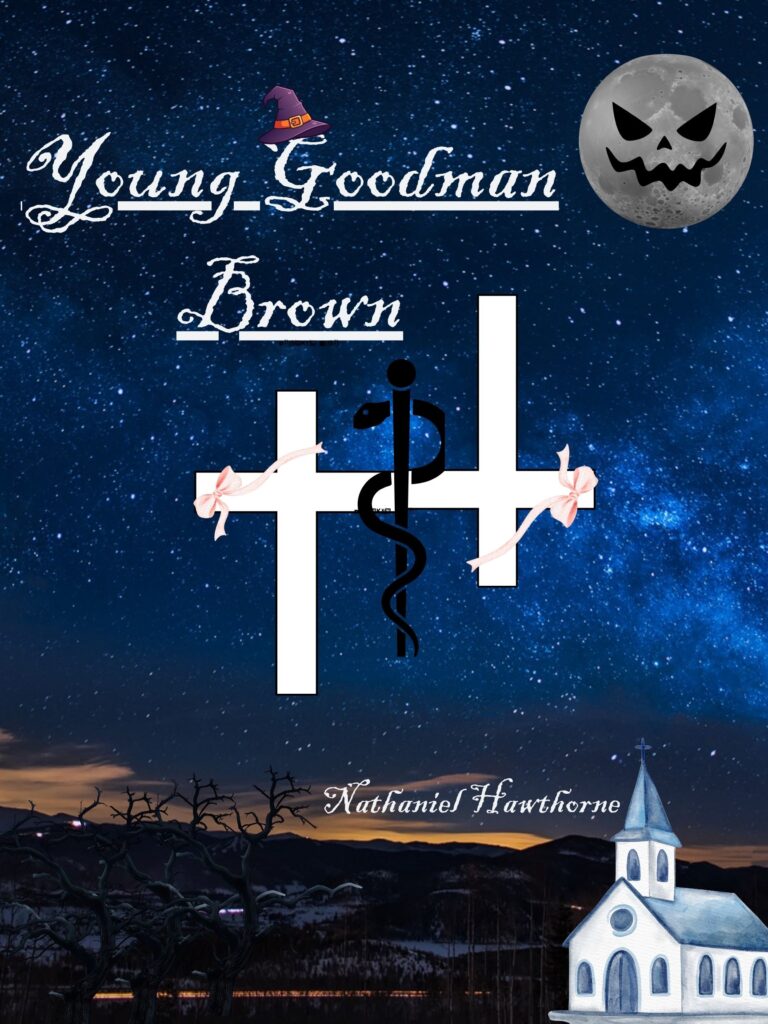
In Nathaniel Hawthorne’s “Young Goodman Brown”, there are many symbolic objects and people that serve the purpose of teaching a lesson. While making the book jacket for this story, I did my best to include multiple of these symbols, considering they each played their own important role. However, while doing so, I wanted to convey one of the many messages that Hawthorne tried to send to his readers. This message serves as a critique of Puritanism, and could be said is a struggle Hawthorne himself was dealing with as a descendant of Puritans. This message is that those who followed Puritan beliefs were forced to seek out the sin in everybody, which therefore led to a life of misery and constant mistrust in others. In Goodman Brown’s case, as he tries to discover who is an elite Puritan and is then disappointed when the “holiest” people are actually witches, he leans towards sinning himself.
In creating the cover of this story, there were many elements that I knew would need to be included. Each of them have a purpose, and represent an important part of the story. The first element I included in the cover was the visual of a cross and upside down cross. Obviously the cross represents religion, but the upside down cross is meant to visualize “the anti-Christ”, or Satanism. Including both of these shows the two different paths that Young Goodman Brown spends the whole story trying to decide which one to go down. While the devil wants to draw him towards the life of sin, he is remembering his Puritan beliefs that he has sworn to uphold. The two are of equal size and location on the cover as to represent how neither choice seems to outweigh the other when we reach the end of his dream, until he wakes up at least. Both the option of joining the devil and staying loyal to his faith appear to seem equally as enticing even though according to his religion, the thought of sin should never even be considered. Additionally, including them as the only two options as paths to go down represents how Puritans saw the world. There were no good people who also sinned in their eyes, and you could only be a faithful Puritan elect who was already chosen to go to Heaven, or a sinful follower of the devil. With such a view on the world, they lived in constant misery and made no real connections with others, just how Goodman Brown does after his “dream” has ended.
Another symbol I added were the pink ribbons that belonged to Goodman Brown’s wife, Faith. Faith serves as a pretty obvious metaphor for Brown’s faith in God and his religion. In the story itself, Brown finally starts to break after discovering that his wife may be working with the devil and becoming a witch. The thought of his wife turning her back on God is what sends him over the edge, and causes him to consider following the devil. Though we never actually see Faith as a witch, seeing her ribbons in the vicinity of all the other sinners makes him come to the conclusion that she must be sinning herself, since he’s supposed to search for the sin in everyone. Due to the fact that she is a representation of his faith, the thought of her becoming a woman of the devil was too much to bear, and his literal faith in his religion begins to dwindle away. I found this symbol to be majorly important to Goodman Brown’s mental struggle as a Puritan, and represents far more than just his wife.
The next symbol I used was the serpent staff, which in the story is a belonging of the devil. Though it takes Brown a little while to understand that the old man he met in the woods was actually the devil, this symbol was one of the first hints that this was the case. It’s certainly not the most important symbol, as it doesn’t serve the purpose of conveying Hawthorne’s main message. Despite this, it does feel important because it does show how Brown searched for signs of sin in this man, as he does with everyone, and eventually understood this simple object as a sign. Since the staff also represents the devil and his influence in this story, I placed it right in between the two crosses to symbolize how he is showing Brown the reality of the two paths he could take.
The next two symbols I included in my book jacket are the church and the woods. Both serve as prominent locations in Hawthorne’ s story, and we discover very quickly that they have more in common with each other than expected. They begin to serve as almost positive and negative mirror images of each other, considering those who are considered holy and of the church are also sneaking into the woods at night for a witches meeting. From an outside perspective, readers could consider the woods to be this dark and evil place based on how it’s described plus the fact that it’s home to these meetings with the devil. However, considering those that attend these meetings are people that Goodman Brown has memories of seeing at the church (as important members of it as well), these two places are essentially the same when you look a little further. One location represents God while the other represents the devil, yet the same people are attending events at both locations.
Beyond the visual elements of the book jacket, there was plenty of thought put into the promotional blurbs. When choosing an author from this class to do the blurbs, I had originally thought about using Mary Rowlandson due to her outwardly Puritan beliefs and skewed view on the world due to her religion. This felt a little too easy however, so I returned to the course website introduction of Anne Bradstreet, who was also known for being a Puritan. The angle I took for her as a blurber was that she had the ability to understand the literary choices Hawthorne made because she herself is an author who made specific choices in her writing to make a point as well. In her poem “An Author to Her Book”, she deliberately tries to make it seem like she believes that her writing is so terrible and her book is an “ill-formed child” of her creation. She does this for the purpose of demonstrating the anxiety of a woman writer who may know her work is good, but won’t be accepted by men because she is a woman. Hawthorne does this very similarly, where he makes his reader believe that they’re reading through the eyes of a devoted Puritan fighting off the devil, when in reality his story is a critique of the religion. Bradstreet and Hawthorne have very similar styles in the sense that they make their writing appear to have one meaning, but it actually serves a different purpose. However, being a Puritan who clearly is devoted to the lifestyle of one (as Hawthorne has depicted in his story), Bradstreet can’t accept that her faith can be a negative thing. Though she may know there are underlying messages, she would be far too devoted to her religion to ever consider the issues with Puritanism. Besides not wanting to herself, if she had ever outwardly considered that maybe Hawthorne was right in the sense that the ideas of Calvinism and the elect were unrealistic and manipulative, she likely would have been accused of being a witch.
The other blurber I chose was purely for a little bit of fun, but I did feel like Hermione Granger was a good connection. Her character is both a witch and someone smart enough(and involved with literature) to understand the messages that Hawthorne is trying to convey beyond the depiction of witches. So although she may not have a deeper connection to the story, I felt that two of her biggest traits related well enough to make comments as a blurber.
As a whole, the message I wanted to convey during this project was that Calvinism and the idea of the elect was a poorly constructed mentality that led to a lot of suffering, and people like Nathaniel Hawthorne clearly had to grapple with this generational guilt. Young Goodman Brown served as a critique to Puritan ideologies and demonstrated how seeking out the sin in everyone will lead you to a life of misery, even if you think you can fight off the devil’s convincing opportunities.
Works Cited
Bradstreet, Anne. “The Author to Her Book.” Wadsworth Publishing, 2013.
Hawthorne, Nathaniel. “Young Goodman Brown.” Wadsworth Publishing, 2013.
Paul Lauter. The Concise Heath Anthology of American Literature.Volume 1: Beginnings to
1865, 2nd edition, Wadsworth Publishing, 2013.
