Pitch
Syd Fye Profile Pitch
Possible subjects..
- Delainey Dunkerley
- What I know
- Student at UNE- 1st year
- Marine Bio Major
- Volleyball Player
- Ex-horse back rider
- Ex-track thrower
- Dyslexic + Discalculus
- Volunteer
- Available on Internet
- Old sports stats
- Status in pet food pantry
- What more do I want to know about them?
- Struggles/ overcoming them as a busy college student with a learning disability
- Her high school involvement/ and how it translated to college
- Others to chat with?
- Family
- Teammates
- Friends
- Morgan DaSilva
- What I know
- AT at UNE
- UNE grad
- Works with men’s and women’s teams
- Available on Internet
- Involvement at UNE
- Schooling prior to employment
- What more do I want to know about them?
- How she balances all the teams
- Which team does she find best to work with
- Others to chat with?
- Players who work with her
- Other AT’s
- Athletic Director
- Pitches: Delainey Dunkerley and Morgan DaSilva
- Delainey Angle:
- growing up with a learning disability and still succeeding
- balancing school and volleyball
- Questions
- What has dyslexia made difficult for you?
- Have you had to work harder for things because of your learning disability? How so?
- Have you been able to balance sports and school well?
- What have you had to do in order to balance them?
- Do you find that it’s harder to balance these things at a college level (all involvements and dyslexia)?
- Morgan Angle
- Balancing all the teams
- How she became and AT
- Questions
- How often are you on campus helping athletes?
- Are some teams harder to work with than others?
- Do you see new situations every day or are most athletes getting similar injuries?
- How much schooling goes into being an AT?
- What are the highlights of being an AT?
Questions
- Can you share some background on how you chose to be an AT? Was that your plan going into college?
- What is it like working with so many different teams with so many different people?
- Your schedule seems pretty sporadic to fit all the teams’ practice/game times. How do you handle that? How often are you on campus?
- You went to UNE as a student; did you intend on working for your alma mater?
- What has the process of becoming an AT at UNE looked like? Did you intern?
- Do you see a lot of the same injuries in athletes or have you dealt with all sorts of things?
- What have been some of the highlights of being an AT at UNE?
Outline
Lead
Nut Graph
Quote
Background
Quote
Becoming a trainer
Quote
Recent experiences
Quote
Highlights
Quote
Early Draft
Alumni to Athletic Trainer
By: Syd Fye
Many college and university graduates will find themselves far from their alma mater after graduation. Often their school will not be able to provide the type of job they’re looking for, but for some lucky graduates it has exactly what they hope to do.
Morgan DaSilva, UNE Athletic Trainer, found herself sticking around in Biddeford Maine, home of the Nor’Easters. She finished her master’s degree in summer of 2025, but has been apart of the UNE trainer team far longer than just this past year.
Quote
DaSilva received her bachelor’s degree for athletic training in 2020, when she also began her internship in the AT room. She remained an intern for just a year, and was then promoted to a temporary full-time position in 2021. After just another year, DaSilva found herself officially elevated to full-time athletic trainer.
Quote
DaSilva works with multiple different teams at UNE. These teams include Women’s Volleyball, Women’s Field Hockey, Men’s Lacrosse, Women’s Ice Hockey, and Men’s & Women’s Cross Country. Though she’s always willing to help out with some of the other athletes, these teams remain her focus.
Quote
Those who know Morgan will have discovered how personable and easy to connect with she is. As someone working with young adults at some pretty vulnerable points, it’s a must to be understanding.
Workshop Draft
Alumni to Athletic Trainer
By: Syd Fye
Many college and university graduates will find themselves far from their alma mater after graduation. Often, their school will not be able to provide the type of job they’re looking for, but for some lucky graduates it has exactly what they hope to do.
Morgan DaSilva, University of New England Athletic Trainer, found herself sticking around in Biddeford Maine, home of the Nor’Easters. She finished her master’s degree in summer of 2025, but has been a part of the UNE trainer team far longer than just this past year.
“Honestly, if someone had asked me when I first got to UNE in 2016 for undergrad if I would be in my 6th academic year working here as an athletic trainer, I would probably tell them how crazy they were to even suggest such a thing…. but here we are!” said DaSilva.
DaSilva received her bachelor’s degree for athletic training in 2020, when she also began her internship in the AT room. She remained an intern for just a year, and was then promoted to a temporary full-time position in 2021. After just another year, DaSilva found herself officially elevated to full-time athletic trainer.
“I never intended on working at UNE as my first full time job out of college but I ended up loving the teams and coworkers that I had here and soon could never see myself anywhere else, so I stayed once I was offered a full time position in 2022.”
DaSilva works with multiple different teams at UNE. These teams include Women’s Volleyball, Women’s Field Hockey, Men’s Lacrosse, Women’s Ice Hockey, and Men’s & Women’s Cross Country. Though she’s always willing to help out with some of the other athletes, these teams remain her focus.
“Being able to be a part of all of these teams creates so many bonds with all those athletes and you get to experience working with these athletes to get them back to whatever sport it may be which is what it’s all about.”
Those who know Morgan will have discovered how personable and easy to connect with she is. As someone working with young adults at some pretty vulnerable points, it’s a must to be understanding.
“When I reached high school, I experienced several injuries that required me to work closely with our athletic trainer. I wanted to be that same supportive and trusted person for other athletes that she was for me,” DaSilva said.
“Morgan isn’t even officially my trainer, but she has been very helpful and supportive throughout my rehab process,” said first-year soccer player, Jared Beale, who recently sprained his MCL.
“Coming in as a freshman with a chronic knee injury, I’ve never felt more welcomed and comfortable. Morgan has become more than my athletic trainer, I would also consider her my friend,” said first-year volleyball player, Delainey Dunkerley.
Knee injuries are no stranger to DaSilva, along with essentially every other injury an athlete could have. She works tirelessly to treat every knee, ankle, shoulder, and whatever else comes her way. She finds it extra fulfilling to know that the young adults she assists are students at her alma mater.
“With all the teams that I have I see a lot of different injuries since the sports require different demands and have different amounts of load on different parts ofthe body,” she says.
Clearly the many years of experience have paid off, as DaSilva has developed an understanding of what to expect from each athlete. Her determination to connect with the teams has her prepared for whatever they may come in the training room with.
“Cross country has a lot of overuse injuries, field hockey has a mixture of lower body and back related injuries, volleyball always has injuries varying from upper to lower body, women’s hockey is pretty physical and intense so the injuries are usually more heightened and more serious, and men’s lacrosse is even more physical than hockey,” said DaSilva.
Along with the joy of providing such comfort to her athletes, DaSilva has had the opportunity to be a part of a lot of great moments in the UNE athletic program. Since the AT’s often have to travel with their teams, she’s been able to catch a lot of the on the road action.
“I always look forward to the long overnights and spring break trips like I have taken with softball to Florida many times, men’s lacrosse to Maryland, and women’s ice hockey weekend overnight trips,” said DaSilva.
DaSilva has taken full advantage of everything that UNE has been able to offer her for multiple years. From student to employee, the university has had the pleasure of keeping Morgan around. Her athletes are her biggest priority, and that could not be more clear.
“Some of the best highlights are being able to form relationships and bond with my athletes by being a part of their daily trips to stop in before practice or get ready before a big game… to be a part of their routine and journey is all the highlight I would ever need for my job.”
Workshop Experience
I was absent for the peer workshop due to illness, but I did read over what my group mates added for feedback in Journal 21. I felt like they both were very insightful when it came to providing thoughts about my piece, and I was very appreciative of their opinions. I was happy to see that a lot of my feedback was very supportive, so I feel like I am on the right track with my article. I felt that both of them were very clear about what needed to be tweaked, and did so very respectfully. It helped to see how another person understood the message of my article because it allowed me to go in and make my main points clearer. Both of my group mates reminded me to be careful with how I set up my quotes in this piece because I do have a lot of them, and stacking them could make it awkward for my readers. They also suggested that I share a little bit more about my subject as a person because most of my piece discusses her employment.
I also found the providing feedback side to be helpful as well. Writing out what I saw in my peers’ writing was a reminder to check for these things in my own piece. There were some small things that I picked up on while reading a group mate’s article that caused me to go back and tweak some things that I could see also appeared in my writing. It was unfortunate that I did not get to discuss all of these things in person with my group, but I felt that they wrote out their feedback well enough for me to understand their main points. I hope they felt the same about my written feedback as well, since I couldn’t tell them face to face what I enjoyed and what I would suggest. Overall though, despite the setback, I found my workshop experience to be super helpful!
Final Reviewed Draft
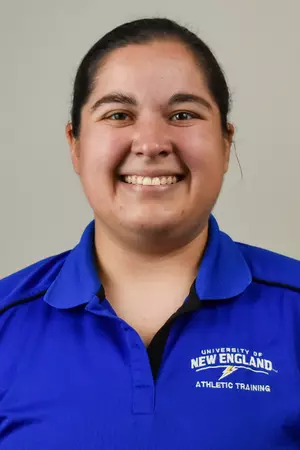
Alumni to Athletic Trainer
By: Syd Fye
Many college and university graduates will find themselves far from their alma mater after graduation. Often, their school will not be able to provide the type of job they’re looking for, but for some lucky graduates it has exactly what they hope to do.
Morgan DaSilva, University of New England Athletic Trainer (AT), found herself sticking around in Biddeford Maine, home of the Nor’Easters. She finished her master’s degree in summer of 2025, but has been a part of the UNE trainer team far longer than just this past year.
“Honestly, if someone had asked me when I first got to UNE in 2016 for undergrad if I would be in my 6th academic year working here as an athletic trainer, I would probably tell them how crazy they were to even suggest such a thing…. but here we are!” said DaSilva.
DaSilva received her bachelor’s degree for athletic training in 2020, when she also began her internship in the AT room. She remained an intern for just a year, and was then promoted to a temporary full-time position in 2021. After just another year, DaSilva found herself officially elevated to full-time athletic trainer.
“I never intended on working at UNE as my first full time job out of college but I ended up loving the teams and coworkers that I had here and soon could never see myself anywhere else, so I stayed once I was offered a full time position in 2022,” said DaSilva.
DaSilva works with multiple different teams at UNE. These teams include Women’s Volleyball, Women’s Field Hockey, Men’s Lacrosse, Women’s Ice Hockey, and Men’s & Women’s Cross Country. Though she’s always willing to help out with some of the other athletes, these teams remain her focus.
“Being able to be a part of all of these teams creates so many bonds with all those athletes and you get to experience working with these athletes to get them back to whatever sport it may be which is what it’s all about,” she said.
Those who know Morgan will have discovered how personable she is. When you’re working with young adults at some pretty vulnerable points, it’s helpful to be so naturally understanding.
“When I reached high school, I experienced several injuries that required me to work closely with our athletic trainer. I wanted to be that same supportive and trusted person for other athletes that she was for me,” DaSilva said.
It’s safe to say that she has succeeded thus far. All sorts of different athletes with all sorts of different personalities have easily been able to connect with Morgan.
“Morgan isn’t even officially my trainer, but she has been very helpful and supportive throughout my rehab process,” said first-year soccer player, Jared Beale, who recently sprained his MCL.
Even students who no longer attend UNE can recall the impact DaSilva had on them and their time as a Nor’Easter athlete. Former UNE field hockey goalie, Greta Jennison, said “Morgan is the perfect balance of professionalism while also maintaining meaningful relationships with her students and athletes. She’s more than just a talented and knowledgeable AT, she is caring and compassionate.”
Even the athletes who haven’t been at UNE very long have already developed a relationship with DaSilva, and consider her to be one of the most accepting people on campus.
“Coming in as a freshman with a chronic knee injury, I’ve never felt more welcomed and comfortable than I have with Morgan. She has become more than my athletic trainer, I would also consider her my friend,” said first-year volleyball player, Delainey Dunkerley.
Knee injuries are no stranger to DaSilva, along with essentially every other injury an athlete could have. She works tirelessly to treat every knee, ankle, shoulder, and whatever else comes her way. She finds it extra fulfilling to know that the young adults she assists are students at her alma mater.
“With all the teams that I have, I see a lot of different injuries since the sports require different demands and have different amounts of load on different parts of the body,” she says.
Clearly the many years of experience have paid off, as DaSilva has developed an understanding of what to expect from each athlete. Her determination to connect with the teams has her prepared for whatever they may come in the training room with.
“Cross country has a lot of overuse injuries, field hockey has a mixture of lower body and back related injuries, volleyball always has injuries varying from upper to lower body, women’s hockey is pretty physical and intense so the injuries are usually more heightened and more serious, and men’s lacrosse is even more physical than hockey,” said DaSilva.
Along with the joy of providing such comfort to her athletes, DaSilva has had the opportunity to be a part of a lot of great moments in the UNE athletic program. Since the AT’s often have to travel with their teams, she’s been able to catch a lot of the on the road action.
“I always look forward to the long overnights and spring break trips like I have taken with softball to Florida many times, men’s lacrosse to Maryland, and women’s ice hockey weekend overnight trips,” said DaSilva.
DaSilva has taken full advantage of everything that UNE has been able to offer her for multiple years. From student to employee, the university has had the pleasure of keeping Morgan around. Her athletes are her biggest priority, and that could not be more clear.
“Some of the best highlights are being able to form relationships and bond with my athletes by being a part of their daily trips to stop in before practice or get ready before a big game… to be a part of their routine and journey is all the highlight I would ever need for my job.”
Reflection
I found this assignment to be the most successful experience I’ve had in this class. I knew going into it that my subject deserved a story that demonstrated what an amazing and hard-working person she is. That being said, I felt that I owed her a well-written story that did demonstrate these qualities of hers. It wasn’t hard to do since I do know my subject personally, but she also gave me some really great quotes that I could build a story around. That was essentially my process, I took a quote of hers that I thought was powerful and then created the story based on the quote. This process made my writing flow pretty easily and I didn’t have a problem reaching word count for each individual checkpoint.
Once we reached peer-review, I think this helped really bring my piece to another level. Using my peers’ suggestions, and using my own suggestions that I gave them, I made some tweaks. There were some things my peers saw that took them out of the story, which obviously was not the goal, so I went through and tried to weed out anything that would cause my readers to be less invested in what I was sharing. After doing so I definitely felt like I was in a good place. I had plenty of quotes from my subject and outside perspectives, I had an angle that I think was pretty clear, and I was able to fill in the gaps between quotes in a way that allowed my subject to tell her story. I’m glad my peers were able to find the issues that they did, because everything they pointed out were things I wouldn’t have originally considered. The peer-reviewing was probably the most helpful part because of this factor, and I thank my group mates for assisting me in elevating my profile.
